
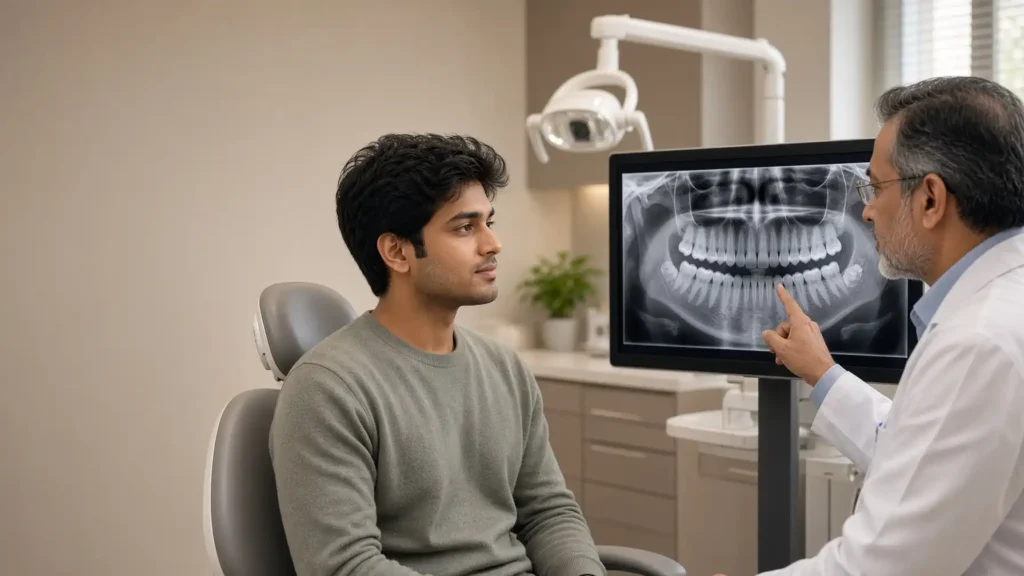
Wisdom teeth are the last set of molars to develop and usually appear between the late teens and mid-twenties. For some people, they erupt normally and remain healthy. For others, there may not be enough room for them to come through properly, or they may become trapped beneath the gum or against another tooth.
When a wisdom tooth becomes problematic, removal may be recommended. But does every wisdom tooth need to be removed? Not necessarily.
The decision depends on the position of the tooth, its relationship with neighbouring teeth, the condition of the surrounding gums and bone, symptoms, and whether there is evidence of disease or damage.
At Aurea Advanced Dentistry in Ravet, Pune, wisdom tooth and other complex dentoalveolar procedures are part of the oral and maxillofacial surgical care offered under Dr. B. M. Rudagi. His professional profile specifically includes complex third-molar surgery and other dentoalveolar procedures.
Here is what you should know before deciding whether wisdom tooth surgery is necessary.
What Is a Wisdom Tooth?
A wisdom tooth is another name for the third molar. Most people can have up to four, with one at the back of each side of the upper and lower jaw.
Wisdom teeth generally develop and erupt later than the other permanent teeth. They usually appear between the ages of 17 and 25, although eruption varies from person to person.
Some wisdom teeth emerge normally and can function like other molars. Others do not have enough room to erupt fully.
When a wisdom tooth cannot emerge properly, it is called an impacted wisdom tooth.
What Does “Impacted Wisdom Tooth” Mean?
An impacted wisdom tooth is one that cannot fully erupt into its normal position because of a lack of space or its relationship with surrounding structures.
It may be:
- Partially covered by gum tissue
- Completely covered by gum or bone
- Angled towards the neighbouring tooth
- Positioned horizontally
- Trapped beneath another tooth or within the jaw
The exact position matters because it can affect both the difficulty of removal and the potential risks associated with surgery.
An X-ray is commonly used to assess the position of wisdom teeth and their relationship with surrounding structures.
Does Every Wisdom Tooth Need to Be Removed?
No.
A wisdom tooth that has erupted fully, is functional, healthy, painless, cavity-free and surrounded by healthy gum tissue may not require extraction. In such cases, regular dental examinations and appropriate imaging can be used to monitor the tooth.
However, a wisdom tooth may need to be removed when it is causing symptoms, disease or damage, or when its position creates a significant clinical problem.
The decision should be based on an individual assessment rather than simply on the presence of a wisdom tooth.
When Is Wisdom Tooth Removal Usually Recommended?
1. Repeated Pain or Swelling
Pain at the back of the mouth can occur when a wisdom tooth is erupting or when the surrounding tissues become inflamed or infected.
If pain or swelling keeps returning, your dentist may investigate whether the wisdom tooth is contributing to the problem.
Persistent or worsening pain should not simply be managed with painkillers without finding the underlying cause.
2. Infection Around a Partially Erupted Tooth
A partially erupted wisdom tooth can leave a flap of gum around the tooth. Food and bacteria can become trapped in this area, making cleaning difficult.
This can result in an infection called pericoronitis.
Symptoms can include:
- Pain around the back molar
- Swollen or tender gums
- Bad taste or bad breath
- Difficulty opening the mouth
- Swelling around the jaw
Repeated infection may be one reason removal is considered.
3. Damage to the Neighbouring Tooth
An impacted wisdom tooth can press against the second molar next to it.
Depending on its position, it may contribute to decay, gum problems or damage involving the neighbouring tooth.
This is one reason your dentist or oral and maxillofacial surgeon may recommend imaging before deciding on treatment.
4. Tooth Decay That Cannot Be Restored
Wisdom teeth can be difficult to brush and floss properly, particularly when they are partially erupted or positioned awkwardly.
If a wisdom tooth develops significant decay and cannot be predictably restored, extraction may be considered.
5. Gum Disease Around the Wisdom Tooth
The area around an impacted or partially erupted wisdom tooth can be difficult to keep clean.
Persistent gum disease around the tooth may affect the wisdom tooth itself and, in some cases, the neighbouring molar. Periodontal disease is one of the clinical reasons commonly considered when deciding whether a wisdom tooth should be removed.
6. A Cyst or Other Pathology
In some cases, a cyst or other pathological change can develop around an impacted tooth.
If imaging identifies a cyst, tumour or other abnormality associated with the wisdom tooth, surgical management may be recommended.
7. The Tooth Is Creating Another Surgical or Dental Problem
There may be situations where a wisdom tooth needs to be removed as part of a broader treatment plan.
The decision depends on the patient’s individual dental condition, the position of the tooth and the overall treatment objective.
What If My Wisdom Tooth Does Not Hurt?
This is an important question.
No pain does not necessarily mean no problem.
Some impacted wisdom teeth produce no obvious symptoms and are discovered during routine dental imaging. An impacted tooth can still be associated with decay, gum disease, damage to an adjacent tooth or other pathology.
At the same time, an impacted wisdom tooth does not automatically mean that surgery is required.
The appropriate approach is to assess the tooth and determine whether removal or monitoring is appropriate for that individual patient.
Why an X-Ray Is Important Before Wisdom Tooth Surgery
The position of a wisdom tooth can vary significantly from one person to another.
Before recommending surgery, your dentist or oral and maxillofacial surgeon may assess:
- The angle and position of the tooth
- Whether it is fully or partially erupted
- The surrounding bone
- The condition of the neighbouring tooth
- The shape and development of the roots
- The relationship with nearby anatomical structures
- Evidence of infection, decay or pathology
Depending on the case, additional imaging may be recommended.
For more complicated cases, three-dimensional imaging may provide additional information for treatment planning.
The goal is not simply to see the wisdom tooth. It is to understand the anatomy around it and plan the safest appropriate approach.
When Does Wisdom Tooth Removal Become “Surgery”?
Not every wisdom tooth extraction is equally complicated.
A fully erupted wisdom tooth that can be accessed easily may sometimes be removed using a relatively straightforward extraction technique.
An impacted wisdom tooth may require a surgical approach.
Depending on the position of the tooth, surgical removal can involve:
- Local anaesthesia or another appropriate form of anaesthesia
- Accessing the tooth through the gum
- Removing a small amount of surrounding bone when necessary
- Dividing the tooth into sections in selected cases
- Removing the tooth carefully
- Cleaning the area
- Placing sutures when required
The exact technique depends on the tooth’s position, root anatomy, surrounding bone and the patient’s individual circumstances.
Who Should Remove a Difficult Wisdom Tooth?
A straightforward wisdom tooth may be manageable in a general dental setting.
However, impacted or surgically complicated wisdom teeth may require assessment and treatment by an oral and maxillofacial surgeon.
Oral and maxillofacial surgeons receive specialist surgical training involving the teeth, jaws, facial structures and related conditions. AAOMS notes that impacted wisdom teeth are among the common procedures managed by oral and maxillofacial surgeons.
Dr. B. M. Rudagi’s professional profile identifies Oral & Maxillofacial Surgery as his primary specialty and lists complex third-molar surgery among his clinical areas. His broader surgical experience includes dentoalveolar surgery, facial trauma, TMJ surgery, reconstruction, pathology and implant-related procedures.
What Should You Expect During Wisdom Tooth Removal?
The experience varies depending on how complicated the tooth is and what type of anaesthesia is used.
Before surgery, your clinician should review your medical and dental history, examine the tooth and discuss the planned procedure.
You should also have an opportunity to ask questions about:
- The reason for removal
- Alternatives to removal
- The expected surgical approach
- Anaesthesia
- Potential risks
- Recovery
- Follow-up care
For impacted wisdom teeth, the procedure is generally performed as an outpatient procedure. The duration varies depending on the number and position of the teeth and the complexity of the case.
Will Wisdom Tooth Surgery Hurt?
During the procedure, appropriate anaesthesia is used to control pain.
After the procedure, it is normal to experience some discomfort, swelling and tenderness as the area heals. The intensity varies from patient to patient and depends on the complexity of the surgery.
Your surgeon will provide instructions regarding pain management, diet, oral hygiene and activity during recovery.
What Should You Expect After Surgery?
The first few days are generally focused on protecting the surgical area and allowing the initial healing process to begin.
Your dentist or surgeon may recommend:
- Soft foods initially
- Careful oral hygiene around the surgical site
- Avoiding smoking
- Avoiding foods that can irritate or become trapped in the wound
- Following prescribed medication instructions
- Using cold compresses when advised
- Attending the recommended follow-up appointment
It is important to follow the specific postoperative instructions provided by your surgeon because recovery can vary between patients.
What Are the Possible Complications?
Wisdom tooth removal is a commonly performed procedure, but it is still surgery and complications are possible.
Potential complications include:
- Bleeding
- Infection
- Dry socket
- Swelling and discomfort
- Temporary difficulty opening the mouth
- Temporary numbness or tingling
- Injury to nearby nerves in selected lower wisdom tooth cases
The risk depends on factors such as the tooth’s position, root anatomy, surrounding structures and the patient’s individual circumstances.
Your surgeon should explain the risks specific to your case before treatment.
When Should You Contact Your Dentist After Surgery?
Contact your dental team if you experience symptoms that are severe, worsening or outside what you were told to expect.
Particularly important warning signs include:
- Bleeding that does not stop
- Severe or increasing pain
- Increasing swelling
- Fever or feeling unwell
- A bad taste associated with worsening symptoms
- Other concerns about healing
Seek urgent professional advice rather than trying to manage significant symptoms yourself.
How Can You Prepare for Wisdom Tooth Surgery?
Good preparation can make the process easier.
Before your appointment:
Tell your dentist about your medical history
Provide information about your medications, allergies and relevant medical conditions.
Follow instructions about eating and drinking
Your instructions will depend on the type of anaesthesia or sedation being used. Follow the specific instructions provided by your dental team.
Arrange help if needed
If sedation or general anaesthesia is planned, you may need someone to accompany you and help you get home.
Prepare soft foods
Having suitable foods available before surgery can make the first few days more comfortable.
Ask questions before the procedure
Do not wait until the day of surgery to raise concerns. Ask about the procedure, recovery, medication, expected swelling and anything else you are unsure about.
7 Questions to Ask Before Wisdom Tooth Removal
Before agreeing to surgery, consider asking:
- Why does this wisdom tooth need to be removed?
- Is the tooth impacted or partially erupted?
- What does my X-ray show?
- Is the neighbouring tooth at risk?
- What type of extraction or surgery will I need?
- What are the risks specific to my tooth’s position?
- What should I expect during recovery?
These questions can help you understand the treatment rather than simply deciding based on the presence of a wisdom tooth.
Wisdom Tooth Removal in Ravet, Pune
Wisdom tooth problems can range from a straightforward extraction to a more complex surgical case. The right approach depends on the individual tooth and the surrounding anatomy.
At Aurea Advanced Dentistry in Ravet, Pune, oral and maxillofacial surgical care includes wisdom tooth and dentoalveolar procedures under the expertise of Dr. B. M. Rudagi. His documented clinical profile includes complex third-molar surgery alongside broader oral and maxillofacial surgical care.
The first step is not always removal. It is proper assessment.
If your wisdom tooth is causing pain, repeated swelling, infection, difficulty opening your mouth, damage to a neighbouring tooth or another dental concern, a clinical examination and appropriate imaging can help determine whether extraction is necessary.
A wisdom tooth should not be removed simply because it is a wisdom tooth. The decision should be based on its position, condition, symptoms, surrounding structures and your individual dental needs.
For personalised advice, consult a qualified dentist or oral and maxillofacial surgeon who can examine your wisdom tooth and recommend the appropriate treatment.